
The West makes citizens of its immigrants, and some become lawmakers. Thailand won’t even let its new citizens run for mayor.
After 12 years in Thailand, a Thai wife, Thai tax filings and a second house under construction, the writer known as Jay is still an alien. That is not an insult. It is his legal status.
The word alone is an insult. To most people, an alien is a creature, organism or intelligence from another planet. Thailand, of course, uses the same lingo as U.S. immigration law.
In an essay for Khaosod English, Jay writes that he doesn’t need the state to tell him where home is. “But I will need its permission to continue living there till the day I die.”
His complaint is modest. He doesn’t expect the law to change for him, and he doesn’t think spending money should buy special treatment. But it points to a larger truth. Thailand welcomes foreigners as customers and guests, and its legal system makes sure they stay that way.
Thai people are famously hospitable to outsiders. Thai law is not. Where belonging is concerned, this is a xenophobic society by design.
Grateful guests
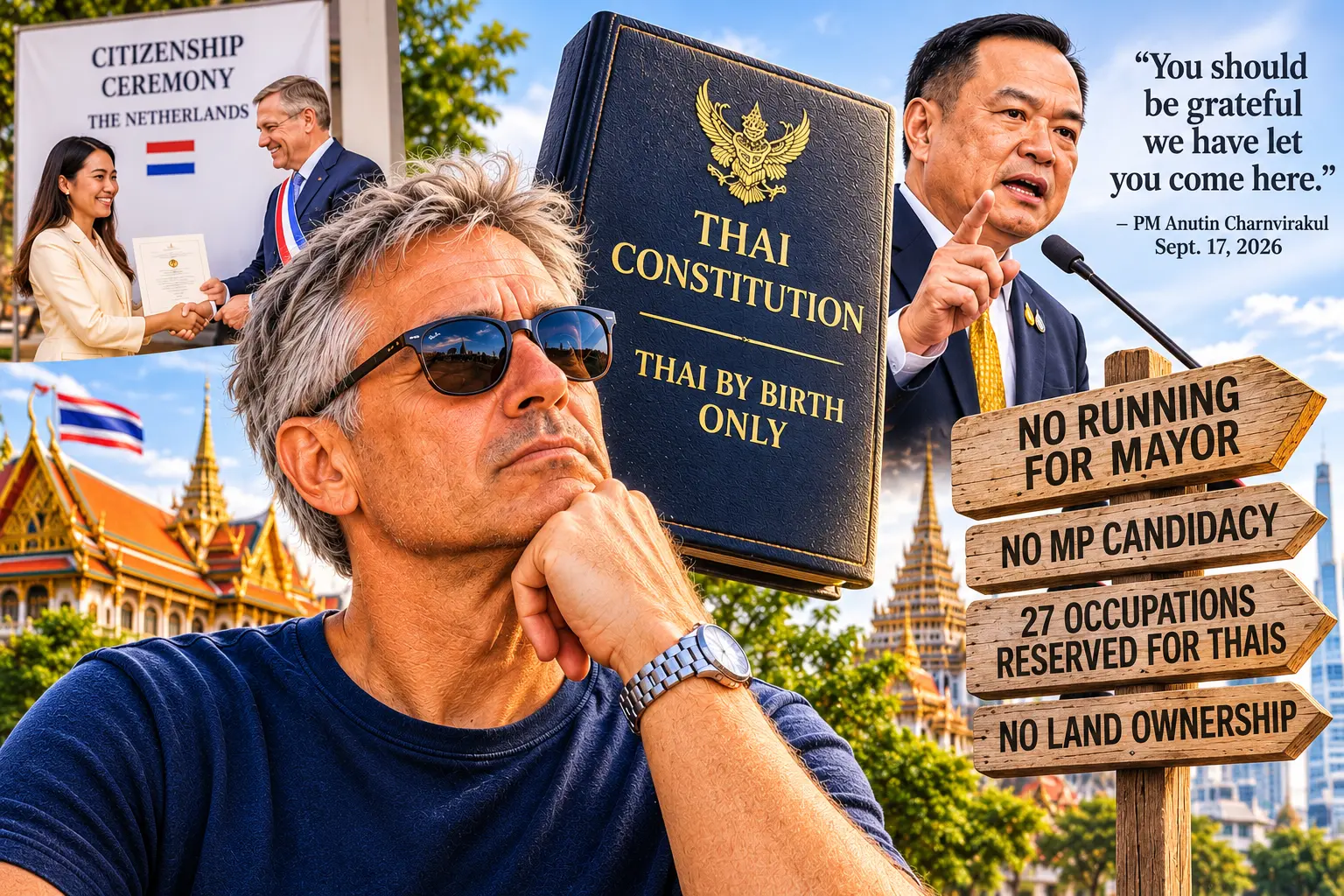
Jay’s essay was prompted by remarks from Prime Minister Anutin Charnvirakul. Told of a request for a private cemetery, Anutin said on Sept. 17: “You should be grateful we have let you come here. Come here to earn an honest living. If you are going to die, go and die back home. You do not need to die here. And do not exploit us.” A Western politician who said such words would be drawn and quartered.
Anutin was addressing foreign lawbreakers and said Thailand is still happy to welcome those who come honestly. Jay acknowledges that context. But the language reveals the underlying view: Foreigners are here by permission, and they should be thankful.
Jay recalls a different experience in the Netherlands, where his Thai wife became Dutch after a few years. There was a ceremony, a certificate and a handshake from the mayor. Back in Thailand, she is a citizen and he is an alien.
A door barely open
Even the formal way out is close to shut. As Thaigest reported last month in “Thai Citizenship: From Bureaucratic Gauntlet to Mission Impossible,” the Department of Provincial Administration is only now reviewing applications filed in 2020. The last list of newly naturalized citizens appeared in April 2024.
Thailand’s ordinary naturalization process grants citizenship to only a few hundred people a year. Royal Gazette announcements recorded 173 successful applicants in 2020, 191 in 2021, 175 in 2022 and 211 in 2024. Since then? None. Germany, by comparison, naturalized 332,524 people in 2025 alone. Even Japan, hardly known for an open immigration policy, approved 9,258 naturalizations that year.
Thai, but not Thai enough
Those who do get through find that a passport does not make them equal. Candidates for Bangkok governor, Pattaya mayor and both city councils must be Thai by birth, the Election Commission said in April. Under the constitution, the same rule applies to members of parliament, senators and Cabinet ministers. New citizens must wait five years just to vote.
Citizenship can also be taken back: The constitution protects only nationality acquired by birth from revocation. Last month, Anutin revoked the citizenship of an Israeli-born gem dealer who naturalized in 2019, citing his continued use of an Israeli passport and a concealed Uruguayan nationality.
Compare that with elsewhere. Somali-born Ilhan Omar sits in the U.S. Congress. Spanish-born Anne Hidalgo was elected mayor of Paris in 2014. Moroccan-born Ahmed Aboutaleb ran Rotterdam for 15 years as an appointed mayor. Even in Japan, Finnish-born Marutei Tsurunen won a seat in the national parliament.
These careers met resistance. Dutch populist Geert Wilders called Aboutaleb’s appointment ridiculous. Immigration is also a fierce fight across the West. But in those countries, a naturalized citizen can run for office and let voters decide. In Thailand, the law decides for them.
The fear of foreign influence
Foreigners are also shut out of everyday work. Twenty-seven occupations are strictly reserved for Thais, including hairdressing, tour guiding, Thai massage, street vending and clerical work. They cannot own land, which is why Jay’s wife bought the plot for their new home. Even the owner of a newspaper must be Thai, under the constitution.
The anxiety runs deep. In June, a Phuket Facebook page warned that the government would let newly naturalized foreigners enter politics at every level. A government spokesperson urged the public not to worry, saying candidacy would remain subject to the constitution and other laws. It was a telling reassurance: Don’t be afraid, the new citizens still won’t be able to run.
Some of the concern has real causes. Authorities say they have identified more than 240 businesses on two islands that exploited nominee structures. Every country has the right to set its own rules, and Thailand is not obliged to copy Germany. But catching lawbreakers does not require treating a man with 12 years of tax filings and a Thai wife as a permanent guest.
Jay’s real question is whether someone can ever stop being a guest. In Thailand, the law’s answer is no. Aliens shall stay aliens.
1 thought on “Once an Alien, Always an Alien: Thailand’s Xenophobia Is Written Into Law”