
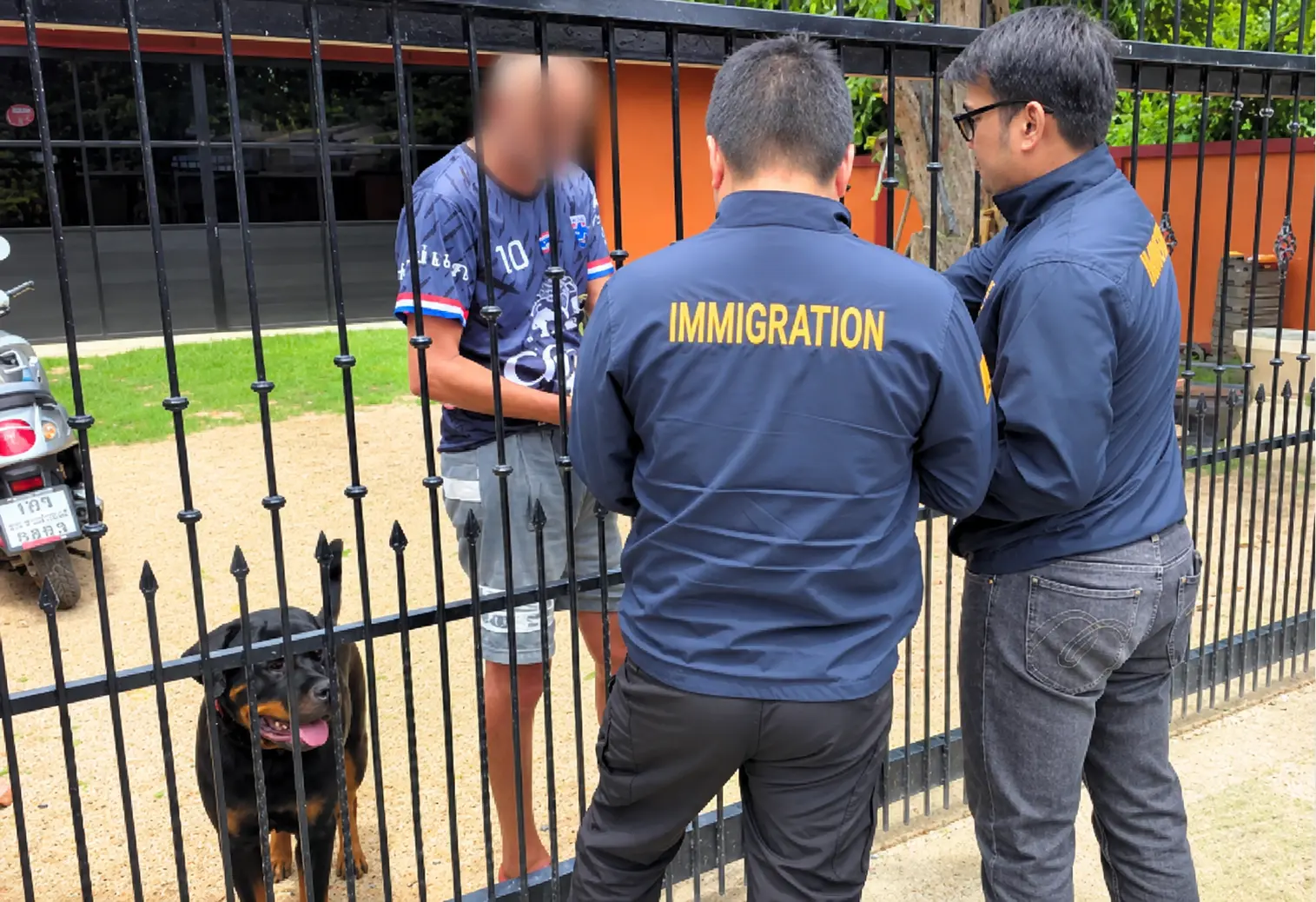

A Swiss man in Hua Hin has lost his permission to stay in Thailand after an immigration inspection, and officials have not said publicly which requirement he failed to meet.
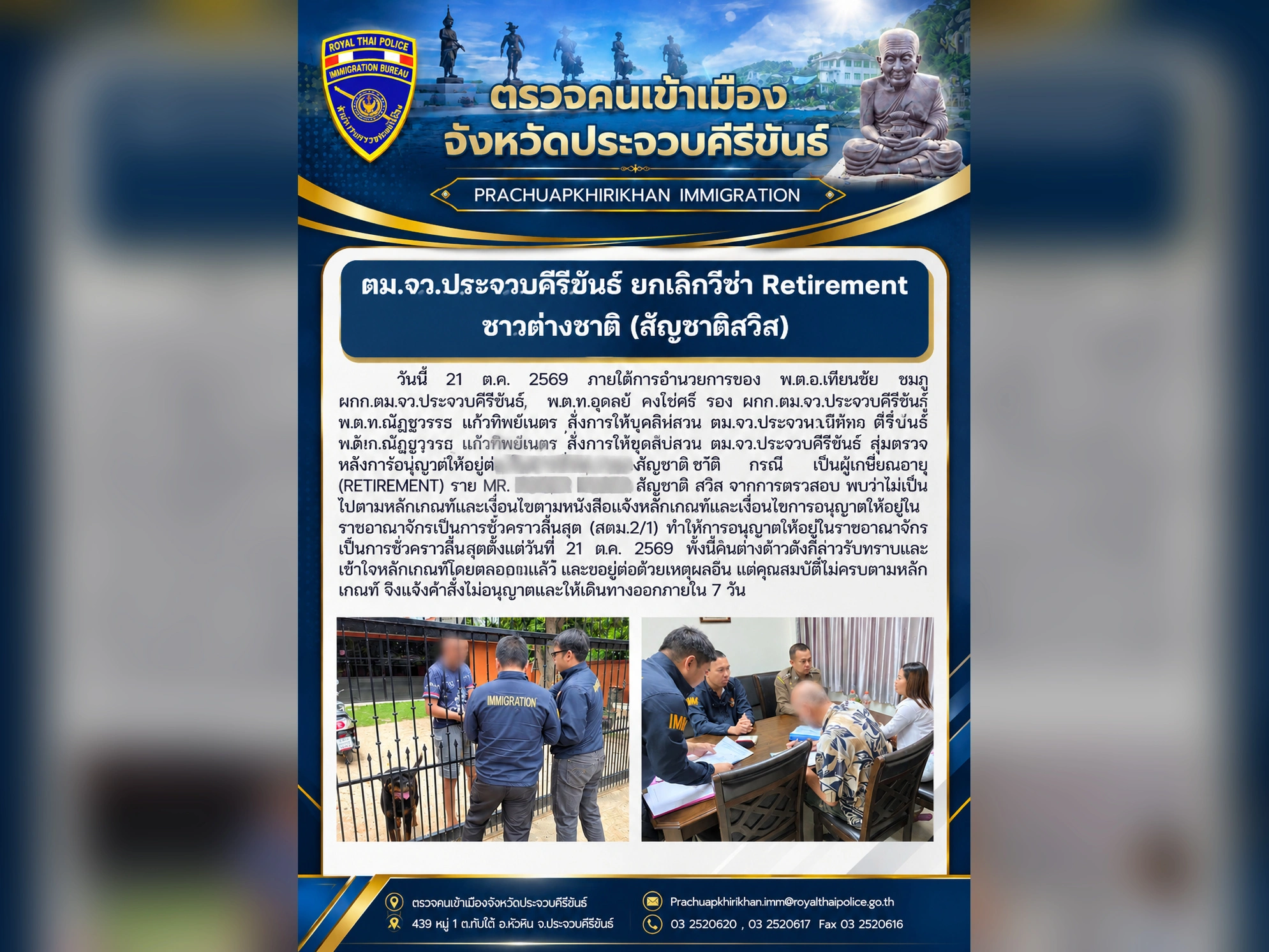
Prachuap Khiri Khan Immigration said the retirement-based permission to stay of Roger H.* was terminated Oct. 21 after officers found he no longer met the applicable criteria and conditions.
H. then sought permission to remain on another basis. Immigration said he did not meet the requirements and instructed him to leave within seven days.
The announcement does not identify the failed requirement or explain what prompted the inspection. Thailand’s retirement rules offer several possible explanations, but none has been confirmed.
The 800,000-baht question
The financial requirements are the most obvious place to look.
Foreigners 50 and older seeking a one-year retirement extension must show monthly income of at least 65,000 baht, keep at least 800,000 baht in a Thai bank account, or combine annual income and savings to reach 800,000 baht.
The deposit route can catch people out. The money generally must be in the account for at least two months before the application and three months after approval. After that, the balance must not fall below 400,000 baht.
Under the combined route, at least half of the qualifying deposit must remain after the initial three-month period.
A badly timed withdrawal could therefore put a stay at risk, even if the money was there on application day. So could income that no longer reaches the required level or cannot be properly documented.
In other words, having sufficient funds when applying is not necessarily enough. Retirees must also observe the rules governing what happens to that money afterward.
Could insurance be the problem?
Holders of a Non-Immigrant O-A visa must generally carry health insurance of at least $100,000 or 3 million baht. A lapse in coverage or inadequate insurance could explain the decision if H.’s status was based on that visa.
The requirement does not apply to every retirement extension, however. Many retirees qualify through a Non-Immigrant O visa, which does not carry the same insurance condition.
The immigration announcement does not identify which visa category H. held. Insurance therefore remains one possibility, not an established explanation.
A spot check, not a rejected renewal
Immigration did not simply refuse to renew H.’s permission to stay. According to its announcement, officers inspected his circumstances while he already held permission to remain in Thailand.
The notice refers to the criteria and conditions governing his temporary permission to stay, including form TM.2/1. That suggests officials were examining whether the conditions attached to an existing permission continued to be satisfied, rather than waiting for his next annual renewal.
The distinction matters. Under Immigration Bureau Order 12/2568, which governs temporary stays, permission can end if a foreigner no longer meets the criteria or conditions under which it was granted.
For retirement extensions, that makes the financial requirements particularly important. Authorities can look beyond whether an applicant had sufficient funds on the day an extension was approved.
But the announcement does not explain whether H.’s case involved a financial shortfall, inadequate documentation or another condition.
At the mercy of immigration?
Thailand’s Immigration Act also gives senior immigration authorities considerable discretion. Section 36 allows the director-general or Immigration Commission to revoke previously granted permission to stay where there are circumstances justifying it.
An appeal against a revocation ordered by the director-general must be filed within 48 hours of being notified. A decision by the Immigration Commission is final.
It is not clear whether Section 36 was invoked in H.’s case. His situation may instead have been handled under the conditions governing retirement extensions.
Either way, the practical consequences can be severe. Once permission to stay has ended, remaining in Thailand without another valid basis can constitute an immigration offense, punishable by up to two years in prison, a fine of up to 20,000 baht or both.
H. was instructed to leave within seven days after his alternative request was refused.
What retirees can take away
The case is a reminder that permission to stay is conditional. Bank balances, income evidence and, where applicable, insurance may need to satisfy the rules throughout the year, not only on renewal day.
Thailand has every right to enforce its published immigration requirements. But foreigners also have a legitimate interest in knowing precisely which conditions they are expected to meet and why an existing permission to stay can be terminated.
This single case does not establish a broader crackdown on retirees in Hua Hin. Immigration’s decision to publish it, accompanied by photographs of the inspection, does suggest it wanted the case to be seen.
Thailand’s Immigration Bureau has already publicized a campaign against visa abuse, reporting more than 14,000 arrests of overstayers and illegal workers from January to May, and a new purge is under way. But nothing in the notice says H. overstayed.
The key questions remain unanswered: What exactly did officials find that made H. ineligible to remain in Thailand? And why him? The notice calls it a random check. Was it really routine? Or was there a tip-off.
* Name known to Thaigest