
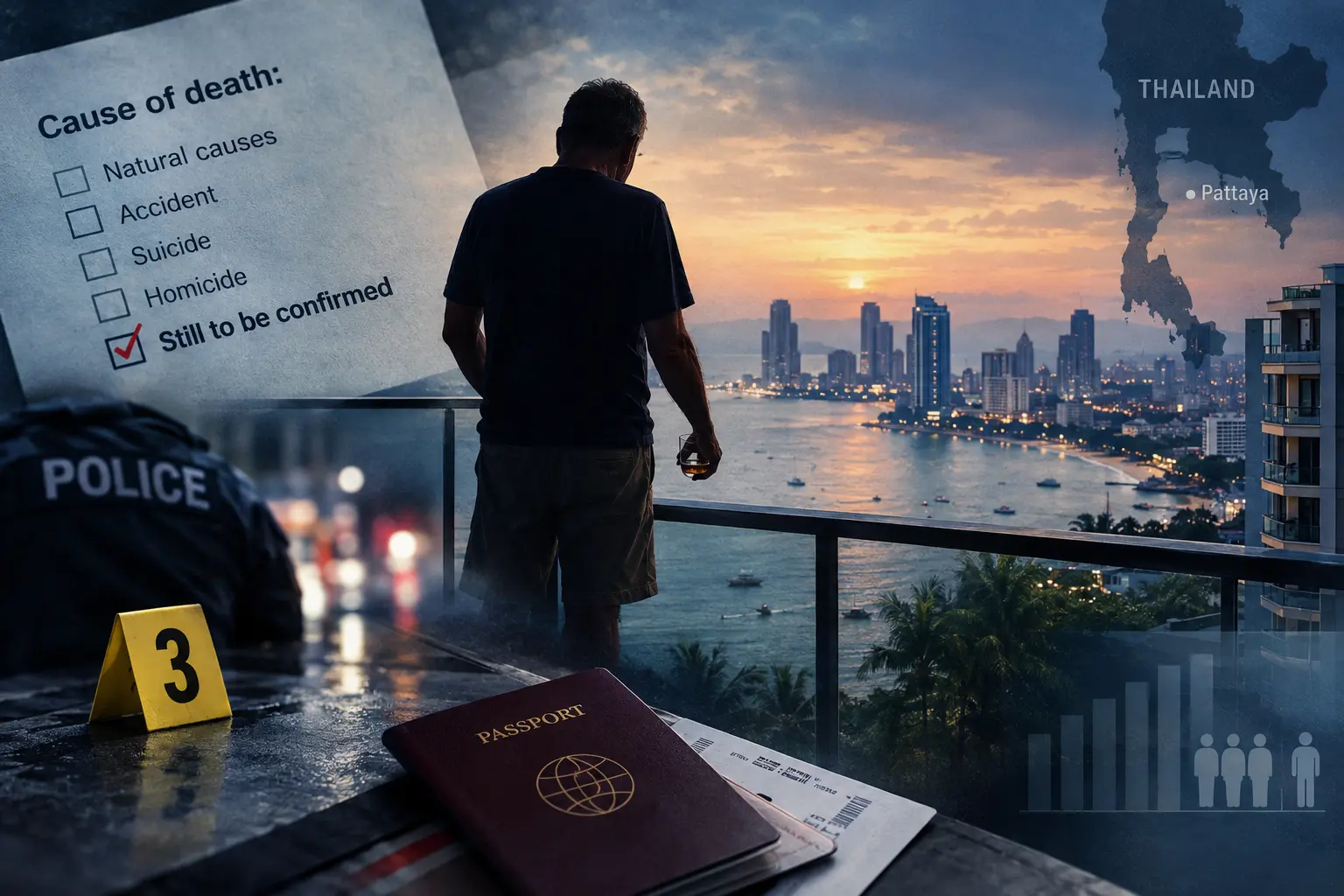
The latest came at 3:06 a.m. Wednesday. A foreign man, believed to be between 25 and 40, was found in the parking area below a high-rise condominium on Sukhumvit Road in Naklua, north Pattaya. Police believe he fell from around the 29th floor. They found no obvious signs of assault, and security camera footage did not show how he came to fall, Thaiger reported. His name and nationality had not been released.
It was the second such death in Pattaya in six days. On Oct. 23, a 61-year-old Chinese man died in a fall from another condominium in the city.
The pattern is so familiar that expats gave it a grim nickname, the “Pattaya Flying Club.” A foreign man, often middle-aged or older, lands on a hotel driveway or a condo parking lot sometime after midnight. Police find no struggle in the room. Within days, the case is filed as suicide or an accident — or simply left open.
In the first days of June 2024, five non-Thais fell from Pattaya condominium balconies in five days, Pattaya Mail reported. The Bangkok Post’s list from that month included a 38-year-old Russian who fell from a condominium on June 3, a 43-year-old American who fell from a hotel balcony on June 4 and a 57-year-old German who fell from the 33rd floor of a beachfront hotel a few days later. In the German’s room, police found no sign of a struggle. Days later, a woman of unknown nationality fell from the 25th floor of a Pattaya condo in the early hours.
Pattaya gets the nickname, but Bangkok has a steady toll of its own. In April 2026, a 38-year-old foreign man died after falling from the 25th floor of a hotel on Sukhumvit Soi 24. Weeks later, another foreign man died in a fall from a hotel on Sukhumvit Soi 11; police said CCTV and forensic findings suggested he was alone beforehand, though they were still examining a knife and injuries found with him. In September 2025, a 21-year-old Moroccan tourist died after a fall from a hotel on Sukhumvit Soi 13.
A few years back, a good friend of mine, German, her name was Doris, jumped from a Penthouse floor in Pratunam. It was an early Sunday morning, she and her husband just came home and quarreled. She jumped. Police asked the husband a few questions, yes they were drunk. That was it, case closed.
In absolute numbers, the capital may well record more such deaths than Pattaya. A 2016 Khaosod English review found that Pattaya, a far smaller city, had many more falls per head — which is why it, not Bangkok, gave the phenomenon its name.
Readers keep asking the same question: Can so many foreign men really be jumping or slipping? Thaigest set out to find the numbers. The short answer is that nobody in Thailand keeps them, and the deaths are rarely investigated deeply enough to settle the doubt either way.
What the numbers show
Thailand publishes no count of foreign deaths, and police do not track falls as a category. The 2016 Khaosod English review looked for such data and found none. The best figures come from the dead men’s own governments, and they cover all causes, residents and retirees included.
Britain’s Foreign, Commonwealth and Development Office supported at least 772 cases of a British national dying in Thailand in 2025, up from at least 610 in 2023, according to a written answer to Parliament in February 2026. Recorded suicides were 10 in 2023, 12 in 2024 and seven in 2025. Murder or manslaughter was fewer than five each year; the FCDO withholds counts that small.
The bigger number is the one nobody can explain. The cause of death was “still to be confirmed” for 161 Britons in 2023, 180 in 2024 and 203 in 2025 — roughly 1 in 4. Many are likely pending autopsy reports rather than suspicious deaths. But the FCDO says it records the cause it is told and does not investigate.
| British deaths in Thailand | 2023 | 2024 | 2025 |
|---|---|---|---|
| Cases supported by FCDO (at least) | 610 | 707 | 772 |
| Cause still to be confirmed | 161 | 180 | 203 |
| Suicide or self-harm | 10 | 12 | 7 |
| Murder or manslaughter | fewer than 5 | fewer than 5 | fewer than 5 |
Source: UK Foreign, Commonwealth and Development Office, written parliamentary answer, Feb. 5, 2026
The U.S. State Department recorded 86 non-natural deaths of Americans in Thailand across 2018, 2019, 2020 and 2022. Sixteen were suicides; road crashes, at 35, were the leading cause.
Australia handled 346 deaths of its citizens in Thailand in the year to June 2025, more than in any other country and more than twice the Philippines, which was second. The Department of Foreign Affairs and Trade links that to the many older Australians who retire or marry there.
Local counts are rougher. Pattaya Mail reviewed reported cases in the first half of 2024 and found about 36 foreigner suicides in Pattaya, mostly condominium falls, and said about 95% were men. Pattaya police Lt. Aniruj Jeroh accepted that estimate but told the paper suicides, accidents and murders can be hard to tell apart. The same report said only one Pattaya fall — an American in 2018, caught on video at a party — had ever been definitively shown to be an accident.
For scale: Thailand’s Department of Health counted 5,217 suicides nationwide in 2024, about 8.2 per 100,000 people, and four in five were male.
Is Thailand unusual?
Not in the profile of who falls. Spain has studied its own version, which locals call “balconing.” Doctors at Son Espases hospital in Palma de Mallorca reviewed 46 balcony-fall patients up to 2019. All but one were men, average age 24, and more than 60% were British. More than 95% had high blood alcohol, and about 37% had taken other drugs. The falls happened between 10 p.m. and 7 a.m.
Britain’s Foreign Office has run “booze and balconies don’t mix” campaigns for Spanish resorts since 2012, after a string of deaths in Magaluf. A British inquest later blamed a low wall for one Magaluf death; Spain’s architects countered that the building met European rules.
So the core pattern — men, alcohol, the small hours — is not unique to Thailand, and in Spain it is treated as recklessness, not murder.
What is different in Thailand is the age of many victims and the setting. The Spanish casualties are mostly young holidaymakers. In Thailand they are often older long-stay men, some living alone, some in financial or health trouble, and far from family. Many older hotels and condos also have railings lower than the 1.1 meters required on taller European buildings, according to a Chiang Rai Times review.
Why men, why the early hours
Criminologist Police Lt. Col. Krisanaphong Poothakool of Rangsit University told Khaosod English the explanation would surprise few: alcohol. Pattaya draws foreigners largely to drink, he said.
Other factors recur in police reports: drugs, a quarrel with a partner, isolation, money problems and serious illness without insurance or a way home. Thai police reports on recent falls of tourists in Phuket and Bangkok describe erratic behavior or drug use before the deaths.
None of that answers the suspicion that some falls are staged. It only shows that the official explanations are plausible in many cases.
The investigation gap
That suspicion lives in the gaps of Thai death investigation.
Thailand uses a police-led inquest system. Thai legal scholars have contrasted it with Britain’s independent coroners, U.S. medical examiners and Germany’s judge-led system, and noted that Thai law does not require an autopsy in every case. Britain’s own guidance warns families that the quality of forensic institutes varies widely and that provinces outside Bangkok often cannot do a full post-mortem.
Police have their own reason for caution. Khaosod English reported in 2016 that police risk being sued if they file a murder charge without solid evidence, and that police acknowledged only a few balcony deaths had been investigated as crimes. Pattaya Mail said in 2024 that it knew of no case in Thailand in which a suspected push from a balcony had led to a murder conviction.
Cases do get reopened when evidence is strong. A Swedish man was charged with fatal recklessness in 2017 after his wife fell from a Pattaya balcony; police said they had no solid proof he pushed her. In Phuket, police charged three foreigners with recklessness causing death after a Russian woman’s fall and kept looking for grounds for a murder charge.
Families who doubt the official verdict face a hard road. Cremation is fast and common, and a second autopsy abroad requires embalming and repatriation. Laurie Blackall, whose brother Regan Kelly, 28, was found dead off Patong Beach in January 2025, has petitioned the British Parliament for an independent review of how the FCDO handles deaths abroad. Thai police concluded he drowned; the family is still seeking answers.
What would settle it
The question will not go away until someone counts — and checks. Police could log building falls as a separate category, recording nationality and outcome. Investigators could reconstruct each victim’s last hours, including who last saw them and who was with them. Every unwitnessed fall could require an autopsy by a forensic pathologist. Embassies could publish how many of their citizens’ deaths are still listed as “cause unconfirmed.”
Until then, every early-morning plunge in Pattaya will reopen the same argument and leave the big silent question unanswered — could there ever be any local working girl involved?
If you or someone you know is struggling, help is available. In Thailand, call the Department of Mental Health hotline at 1323 or the Samaritans of Thailand at 02 113 6789 (press 2 for English).
Sources
- Thaiger, foreign man dies in Pattaya condo fall, cause unknown (Oct. 29, 2026)
- ASEAN Now, foreign man dies in fall from 25th floor of Bangkok hotel (April 2026)
- ASEAN Now, foreign man dies after fall from Bangkok hotel (April 2026)
- Khaosod English, Moroccan and Indian tourists die in separate falls (Sept. 20, 2025)
- Bangkok Post, woman dies in Pattaya condo fall
- UK Parliament written answer 108012 (FCDO, Feb. 5, 2026)
- Visit Thailand Today, Thailand safety statistics (FCDO, U.S. State Department and DFAT data)
- U.S. State Department, U.S. citizen deaths abroad
- DFAT, Consular State of Play 2024-25
- Pattaya Mail, “Making sense or nonsense of foreigner suicides in Pattaya” (June 16, 2024)
- Pattaya Mail, Thailand’s suicide numbers top 5,000 per year
- Khaosod English, “The Balcony Did It?” (March 24, 2016)
- Khaosod English, Swede charged after girlfriend falls from Pattaya balcony (April 20, 2017)
- Bangkok Post, foreigners charged over Russian woman’s fall in Phuket
- Bangkok Post, German falls to death from Pattaya hotel
- Wikipedia, Balconing (Son Espases hospital study)
- The Local, true cost of Spain’s balcony-jumping craze
- Chiang Rai Times, balcony deaths in Thailand
- Sukhothai Thammathirat Open University, problems in Thailand’s forensic autopsy process
- UK government, what to do after a British person dies in Thailand
- UK Parliament petition 765131
- ASEAN Now, Brit family still seeking answers after Phuket death