
Thailand still says it welcomes foreigners. It now wants them to sign for that welcome, and to acknowledge on paper how quickly it can be withdrawn.
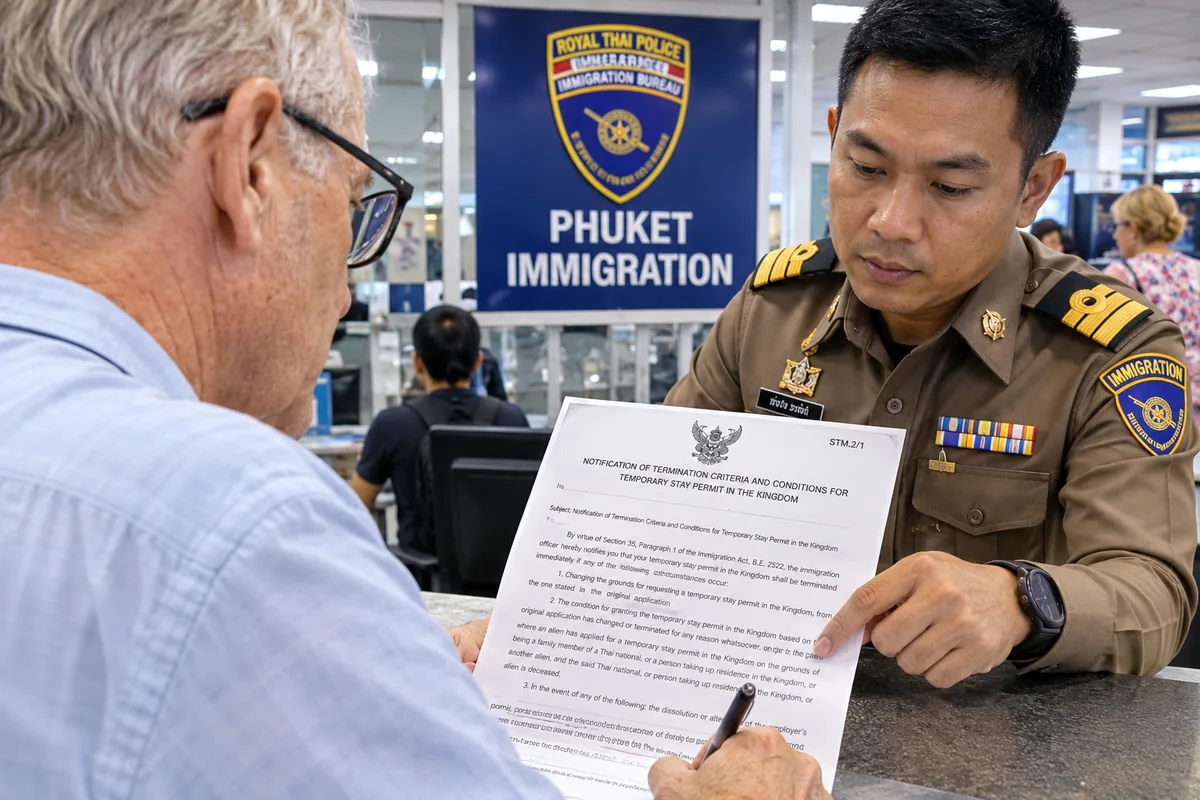
All foreigners applying to extend their stay in Phuket must sign an immigration terms-and-conditions document. Applications from anyone who refuses won’t be accepted, Phuket Immigration chief Pol. Col. Khemchart Wattanapakasem told The Phuket News on Nov. 15.
“If someone does not wish to sign, they simply should not submit an application and leave the country,” he said.
The rule covers every type of extension, including retirement, education, business and marriage. Khemchart said the aim is to make sure foreigners “cannot later claim they were unaware of their obligations.”

‘Not new at all’ — but nobody was told
Khemchart insisted the forms were “not new at all.” But he couldn’t say when the signing procedure started, and Phuket Immigration hasn’t mentioned it on its website or its official Facebook page. Many long-term expats are only now seeing it put in front of them.
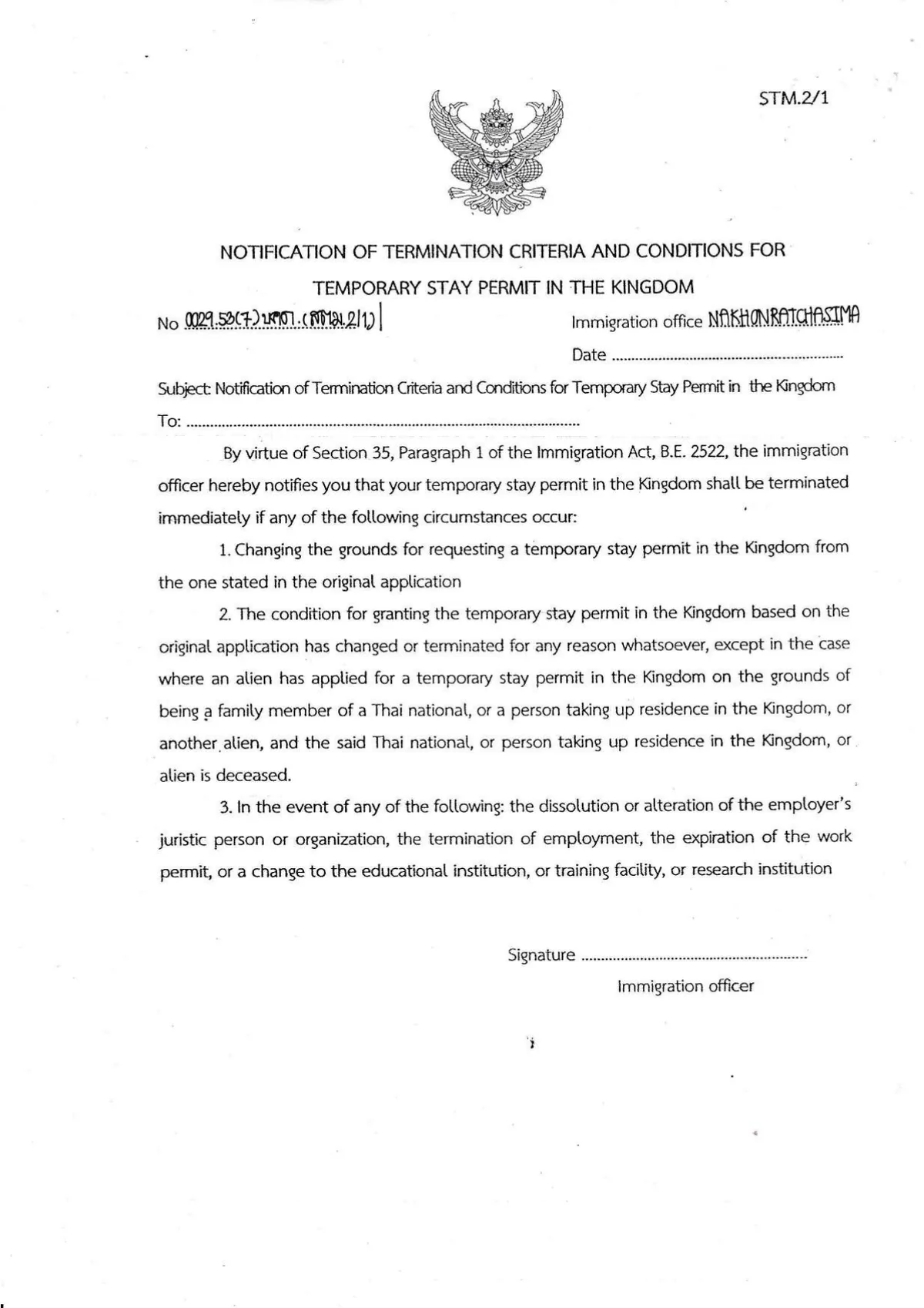
The paperwork comes in two parts. On the older form, STM.2, the applicant signs to confirm they understand the conditions of their stay. The newer one, STM.2/1, goes further. It’s a formal notice from the immigration officer, with an office reference number and the Garuda emblem at the top. Its Thai title translates roughly as “Notification of the criteria and conditions under which temporary stay in the Kingdom ends.”
STM.2/1 isn’t limited to Phuket. In March, the Immigration Bureau listed it among the forms required from travelers stranded by the Middle East airspace closures. A copy seen by Thaigest was issued by the Nakhon Ratchasima immigration office, hundreds of kilometers from Phuket. That suggests the procedure is national, which is what Khemchart said too.
Three ways to lose your stay
Citing Section 35 of the Immigration Act of 1979, the form says permission to stay “shall be terminated immediately” in three cases:
- The foreigner changes the reason for staying from the one given in the original application.
- The condition the permission was based on changes or ends “for any reason whatsoever.”
- The employer is dissolved or changed, the job ends, the work permit expires, or the foreigner switches school, training center or research institute.
There is one exception. If the stay is based on being the family member of a Thai national or a resident, and that person dies, the permission does not end automatically.
In practice, Khemchart said, retirees cannot work, students must actually attend class, and business-visa holders must do business that matches their stated purpose. Retirement applicants must keep 800,000 baht in a Thai bank account for a set period, such as 60 days, before applying, and later withdrawals must also follow the rules.
None of these rules is new. What’s new is that every foreigner now has to sign for them in advance, so that if a case ever comes up, a signed acknowledgment is already in the file.
The message: behave, or be deported
The forms are part of a wider shift in how the state talks to foreigners.
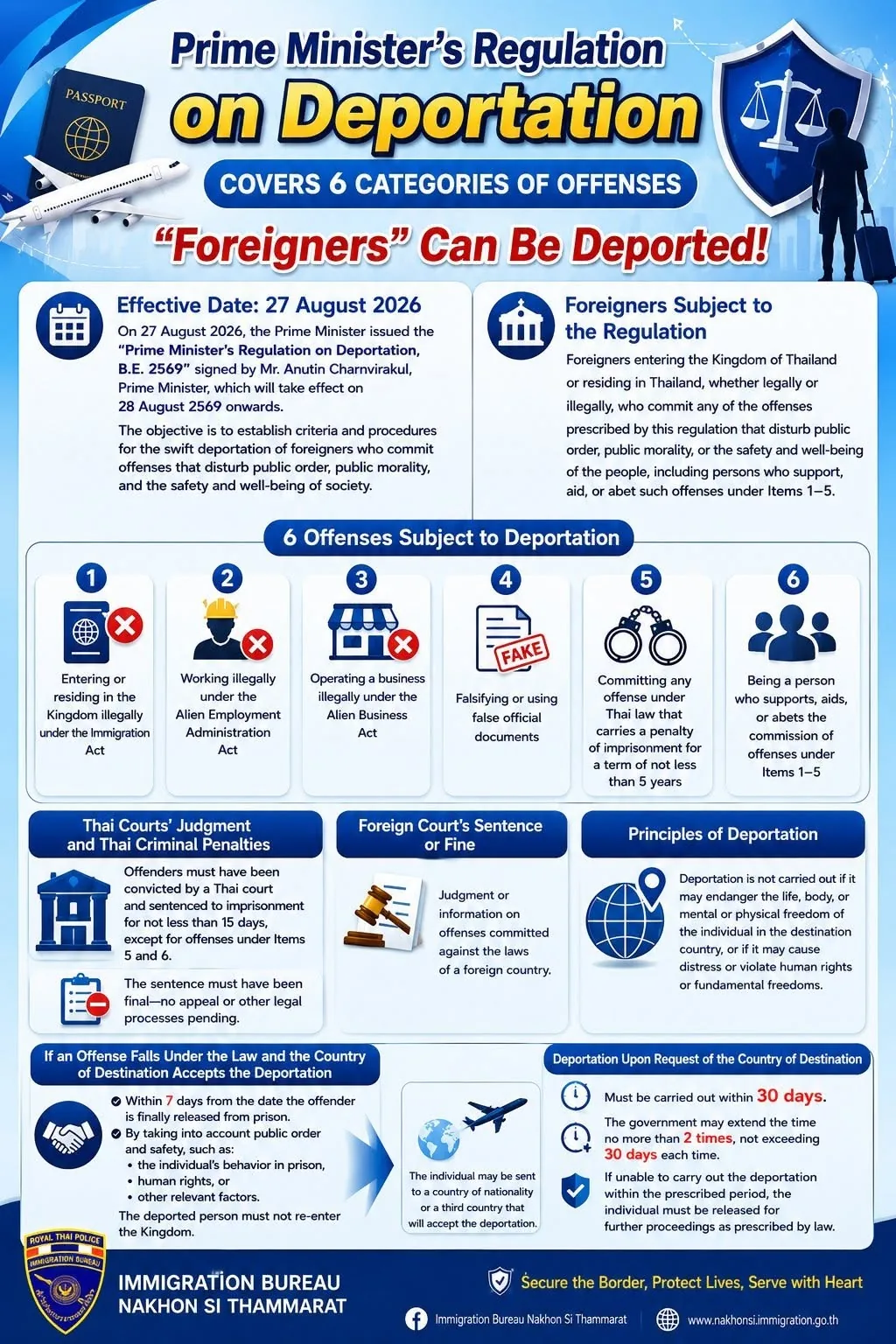
On Aug. 27, Prime Minister Anutin Charnvirakul signed a Prime Minister’s Regulation on Deportation, which took effect the following day. It sets up fast-track deportation for foreigners in six categories:
- illegal entry or stay
- illegal work
- running a business in breach of the Foreign Business Act
- forging or using false official documents
- committing any crime punishable by at least five years in prison
- supporting or abetting any of these offenses
For most of these, the regulation applies after a final Thai court conviction carrying at least 15 days in prison. Deportation is to follow within seven days of release from prison, and the person may not return to Thailand. It is not to be carried out if it would endanger the person’s life or violate their human rights.
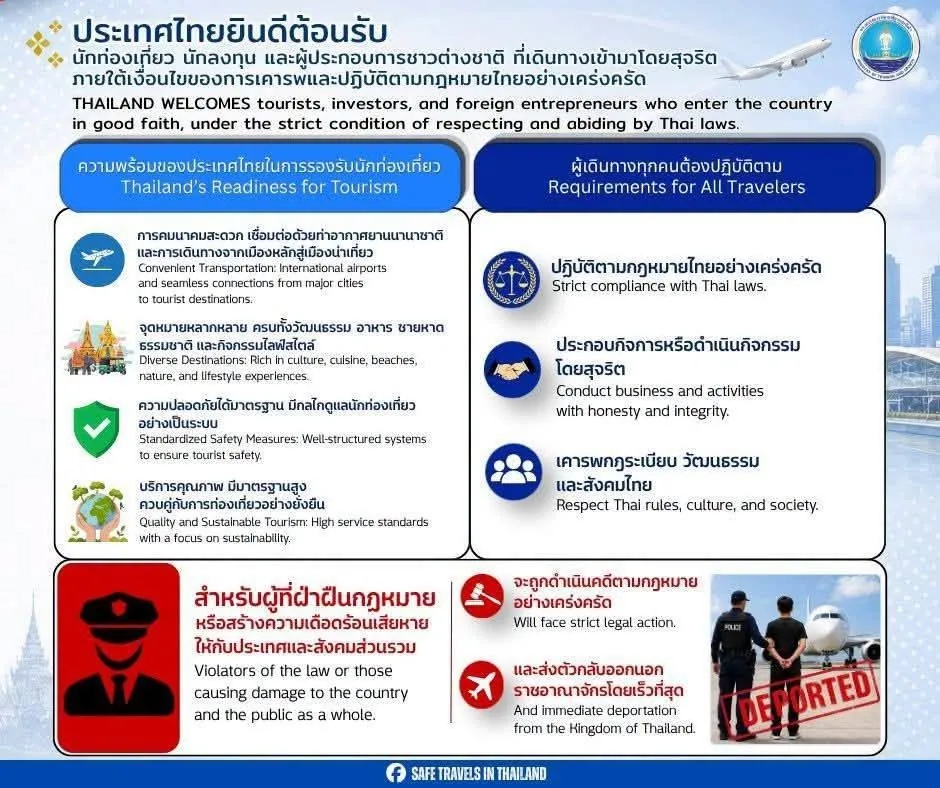
Provincial immigration offices have been promoting the regulation in bold infographics headlined, in English, “Foreigners Can Be Deported!” A separate government graphic shared through the “Safe Travels in Thailand” Facebook page says Thailand welcomes tourists, investors and entrepreneurs who come “in good faith.” Most of the page is about what happens to those who don’t: “strict legal action” and “immediate deportation,” next to a photo of a handcuffed man in front of a plane, stamped “DEPORTED.”
The crackdown has been building for some time. Last year the Immigration Bureau revoked nearly 10,000 temporary stay permits held by foreigners on student visas who were suspected of working illegally. In September, visa-free stays were tightened to a maximum of 30 days.
A familiar script
For many long-stayers, the issue is not the law itself, which most say they follow. It’s the framing. In recent months, overstays, illegal businesses, nominee companies and crimes involving foreigners have been presented to the public as a problem caused by foreigners, and every retiree renewing a one-year extension is now treated as a potential case.
Officials reject that reading. Khemchart said changes in procedure are meant to “modernize” the process and make it more convenient for foreigners, not to change the law.
“As long as all regulations are followed, foreigners will not encounter any issues while residing in Thailand,” he said.
Anyone who doesn’t like the conditions, he added, can apply for a different type of permission to stay, as long as they qualify.
What about… Thais?
One can only wonder when Thailand will apply the same rigor to its own not-always-law-abiding citizens — starting with the officials, landlords and middlemen without whom most foreign rule-breaking would not be possible.