
Thailand keeps changing its political colors. The people holding the paint cans don’t.

Thailand changes its political colors the way a hotel changes its sheets: regularly, visibly and without ever touching the mattress.
Yellow was the color of the establishment. Red was Thaksin’s. Orange promised to rewire the whole system. Now it’s blue’s turn.
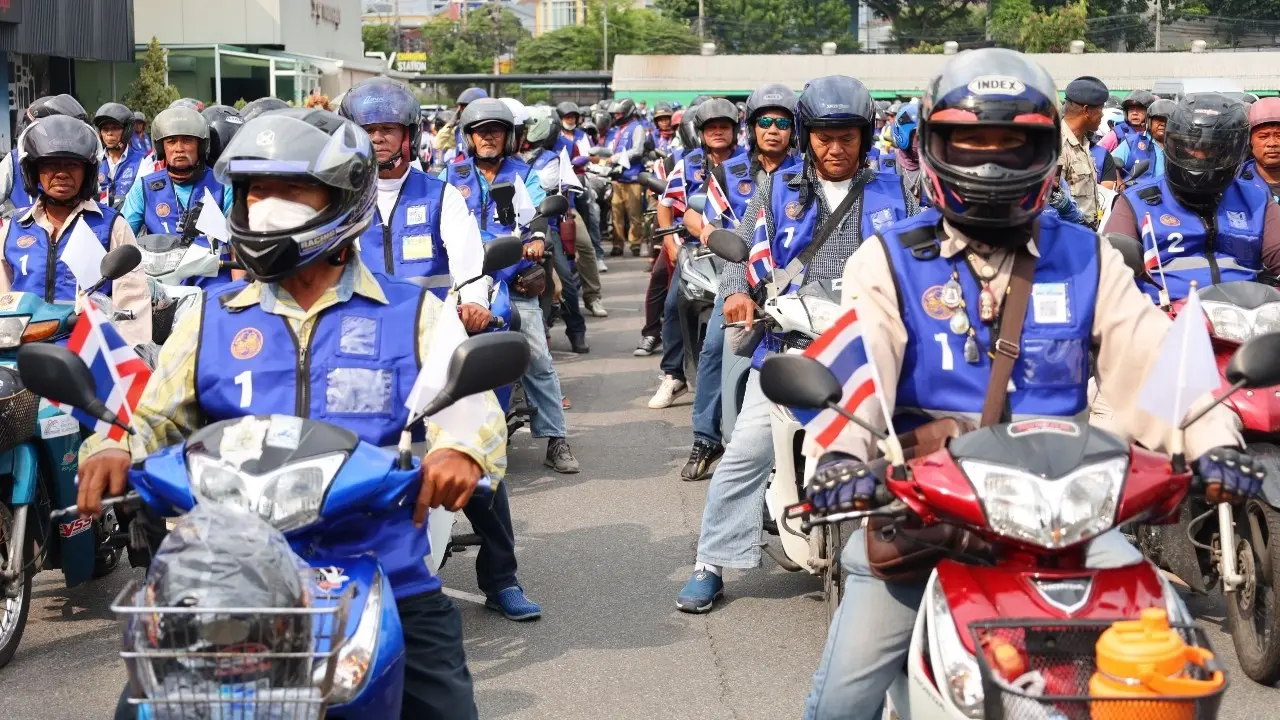
Hey, even Pattaya’s motorcycle taxi riders have switched from orange vests to blue ones.
Blue is Bhumjaithai, the party of Prime Minister Anutin Charnvirakul, which won 193 of 500 House seats in February’s election. The opposition has a name for the political order it believes is taking shape: the “blue regime.”
People’s Party leader Natthaphong Ruengpanyawut laid out the charge in a post timed for the 12th anniversary of the 2014 coup. He described an alliance between Bhumjaithai and a Senate dominated by conservative interests, operating within the framework of the 2017 military-backed constitution. His argument is that the political order established by the coup has found a way to survive without needing another one.
The accusation landed with a bang. About 60 senators held a press conference at the Senate to deny that any blue regime exists.
Nothing says “there is no network” quite like the network calling a press conference.
Some senators went further. Blue, they argued, is one of the colors of the Thai flag, so criticizing a “blue regime” amounts to criticizing the monarchy. Natthaphong said he meant nothing of the sort.
Anutin had his own response. Bhumjaithai, he said, was not an agent of the blue regime but its “manufacturer,” fostering loyalty to the nation, religion, monarchy and people.
So that’s settled.
Each color had its weapon. Yellow had the streets. Red had Thaksin’s mass following. Orange brought a reformist challenge that rattled the establishment. Blue has something potentially more durable: provincial power brokers, electoral machinery, the Interior Ministry under Anutin himself and, according to its critics, influence across key state institutions.
No tanks required. Not as the main attraction, anyway.
The awkward part for the opposition is that blue has managed something the old establishment often struggled to do: win elections. Bhumjaithai secured 193 of 500 House seats, making it the largest party in parliament, though it still needs coalition partners to govern.
That makes blue harder to dismiss. The question is no longer simply whether the old establishment can stop reformers from winning. It is whether it can adapt, build its own electoral strength and keep its influence through the institutions of parliamentary democracy.
Every Thai political color insists it stands for something nobler than power. The real test is whether this shade represents a change of direction or simply a better-organized version of the old order.
So, is blue the new yellow?
Same establishment, new wardrobe?
In Thailand, the shirts change. The tailor never does.